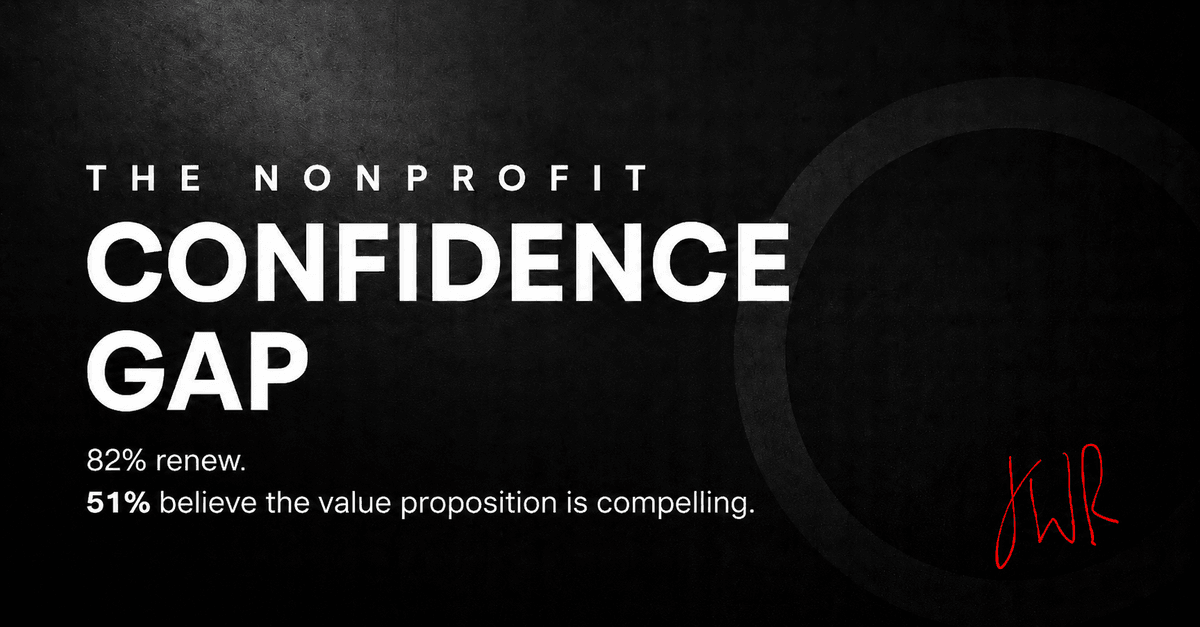
The 2026 MGI Membership Marketing Benchmarking Report has two numbers that really struck me. Associations reported an 82% median renewal rate, while only 51% of association executives called their value proposition compelling or very compelling.
Same report. Same sample.
I noticed this gap in the 2025 report, when the gap was 84% and 57%, and now it's even worse. The report itself now says almost the same thing I thought last year: confidence in the value proposition has slipped, and the real problem for most associations isn't a lack of value, it's an inability to explain it.
That gap should bother us. Read it cynically and it says: we don't understand our own value. 82% of our customers are voting with their wallets and we can't explain why.
That's more than a messaging problem. You can't communicate value you don't understand. You can't connect staff work to it or explain it to a member in a specific way instead of a generic one.
And this isn't a junior staff problem. The report surveyed executives. If only 51% of the people running these organizations find the value proposition compelling, the confidence gap starts before the message ever reaches anyone else.
The real question isn't whether associations create value. An 82% renewal rate says they do. The question is whether we understand that value well enough to turn it into strategy, communication, and the actual work people do every day.
Too often we don't.
We know our tasks. Launch the conference. Send the renewal campaign. Draft the policy alert. But knowing the job is not the same as understanding why members renew.
That's where the gap starts.
Associations are good at talking about mission, and we should be. The mission is why we exist. But a mission statement is not a value explanation.
An events manager knows they're responsible for registration, room blocks, badges, and the inevitable last-minute fire drill. They may not know the annual meeting is one of the strongest drivers of renewal. They may not know that the hallway conversation they made possible is the thing that turned a new member into a ten-year one.
Maybe they know, but do we want to rely on "maybe?"
That's not a character flaw. It's a structural one. The connection between our work and member value must be made inside the organization, and too often nobody makes it.
The fix isn't complicated, but it's not a one-line slogan either.
It starts with a value message that travels. Not a paragraph, not a strategic plan. One plain sentence or a few bullets that every person on the team can say without notes. If the CEO, the membership director, the policy lead, the events manager, and the comms coordinator all answer "why does membership matter?" the same way, you're there.
Too often we say very different things based on our position. A lobbyist might say that advocacy is a big part of the value. A membership director will point to cost savings programs. Event staff understand conference discounts better than anyone. All these answers are correct, but none of them tell the whole story.
The fix starts at the top, but assembling the message takes everyone.
It takes a real information rhythm, running both directions. Not the annual retreat or the occasional town hall. A regular cadence where leadership explains what the senior staff and the board are deciding and why.
But the rhythm can't only run downhill. Membership staff hear objections that never make it into a board packet. Events staff see where members actually spend their time. Comms staff know which emails get ignored. Operations staff spot problems long before they become strategic concerns. If the only safe response is agreement, leadership isn't getting feedback. It's getting compliance.
Everyone should be able to give the same answer to why membership matters. But they also need to know why their specific piece of it matters. This isn't about making every task feel inspirational. Some work is just work. But even ordinary work gets better when people understand the stakes.
Ironically, associations are better at creating value than explaining it. Members feel it because they live it. Staff catch pieces of it through programs and events and renewals. Leadership hears the raw material in board meetings and member feedback.
But raw material is not a value story. If nobody translates it into something people can repeat, challenge, and use, it gets thinner as it moves through the building. By the time it reaches the people delivering, selling, and renewing that value, it sounds like a list of programs instead of a reason to belong.
The uncomfortable possibility isn't that associations lack value. It's that too many have built organizations where value is experienced by members, scattered across departments, discussed in fragments, and only half understood by the people asked to deliver it every day.
When growth was easy, that gap was tolerable.
Now that every member counts, it's expensive.